In Summary:
Annual water quality reports let residents see what their utility monitors and whether reported results meet drinking water standards. Scientists also study substances that may fall outside routine reporting, including some PFAS, pharmaceutical residues, and microplastics. The article uses examples such as lead leaching from pipes and bacteria spreading through mist to explain why the source and route of exposure matter.
How it applies to Apopka
Apopka draws its drinking water from the Lower Floridan Aquifer and disinfects it with chlorine. The city’s 2025 water quality report offers a local example of how to read the test results. Two samples at the Park Meadow monitoring site measured above 80 parts per billion for total trihalomethanes, which can form during disinfection. The city reported no violation because compliance is based on a running annual average at each site, and those averages stayed at or below the limit. For residents reading the report, the range shows how much individual results varied, while the annual average determines whether a site met the standard. City of Apopka’s 2025 water quality report
*****
Water is vital to life, which is part of why we study what’s in it.
Drinking water isn’t just H₂O – though there are over 15 septillion molecules of it in a standard glass. It also contains natural minerals, dissolved organic and biological matter, and substances that enter from agriculture, industry, consumer products, and water treatment.
Related: Orange County receives a $7 million grant for Wekiwa Springs septic-to-sewer conversions.
Most of these substances are harmless at the concentrations typically found in water. Some are beneficial, and even essential, such as sodium, fluoride, and calcium ions, which build strong bones and teeth. Additionally, these ions balance electrolytes that regulate bodily function.
In fact, drinking large quantities of completely demineralized or distilled water can disrupt the body’s electrolyte balance. This water would dilute the natural sodium levels in blood, potentially causing hyponatremia, a condition with symptoms such as nausea, headache, confusion and seizures.
Most people encounter water-quality science through an annual report from their local water company. It’s usually a couple of pages long with chemical names and numbers in a table. It lists various compounds that may exist in the water, summarizes what tests of the water source have found, and explains whether the water meets government-set standards that promote and protect public health and safety.
These reports provide important information about drinking water safety, but they are not a complete inventory of every substance scientists can detect or are working to understand.
We study a range of contaminants, chemical and biological, that are found in drinking water, with the goal of developing technologies to further safeguard public health. This includes pollutants and pathogens that are not included on an annual water report.
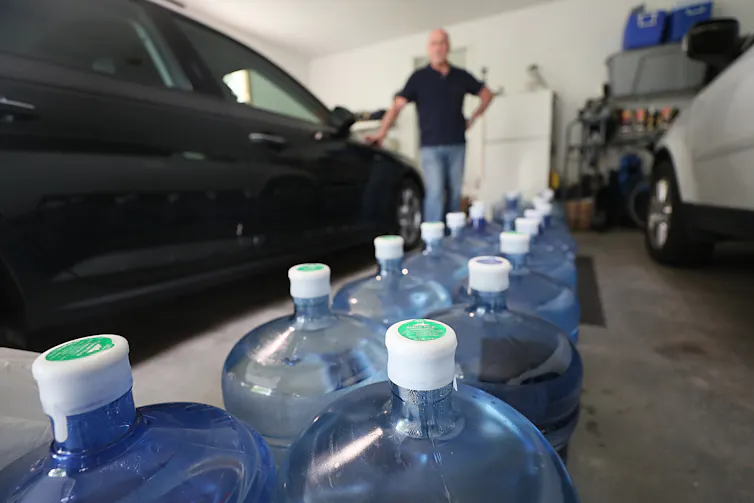 In some communities, high levels of contaminants have led water utilities to supply bottled water to customers. Suzanne Kreiter/The Boston Globe via Getty Images
A secret world of sneaky water pollutants
Consider perfluoroalkyl and polyfluoroalkyl substances, more commonly known as PFAS and also called “forever chemicals” because they persist in the environment for a long time. These are a large family of chemicals used in consumer products because they resist water, oil and heat.
Research has linked exposure to certain PFAS with adverse chronic health effects, such as endocrine disruption, low birth weight in fetuses and certain types of cancer.
Federal drinking water standards now limit the amount of two common types of PFAS found in the environment to 4 parts per trillion, a level extremely hard to detect even on advanced analytical equipment. However, the broader chemical family includes many others whose occurrence and health effects are less understood by scientists and completely missed by the public or policy.
The challenge that water-quality engineers face is not simply to determine whether PFAS, or other compounds and pollutants, are present. Rather, researchers need to understand the concentrations of those chemicals in the water, how people are exposed to them, what their effects on the body are, and how effectively different treatment technologies can remove or destroy them.
What doesn’t kill you … might later
Pharmaceutical residues from medicine that passes through people’s bodies enter sewage systems. Agricultural chemicals such as pesticides flow off croplands into waterways. Both of these types of waste can break down into new, less studied compounds as they move through soil and water, eventually collecting in groundwater or wastewater to be treated and redistributed. The potential long-term effects of these lesser-studied compounds are not fully understood.
Water treatment plants often use chlorine as part of the disinfection process. But when chlorine reacts with natural organic matter, such as decayed plants and microorganisms, it forms disinfection byproducts. These byproducts include chemicals such as trihalomethanes, which are known carcinogens that must be removed with further treatment before the water is safe to drink.
Some contaminants pose an immediate threat; others pose threats that accumulate over time. For instance, ingesting microplastics in drinking water may not hurt you right now, but they are being detected in people’s blood years after exposure. We water-quality scientists want to know not only what’s in the water, but what it might do to your body right away or across decades.
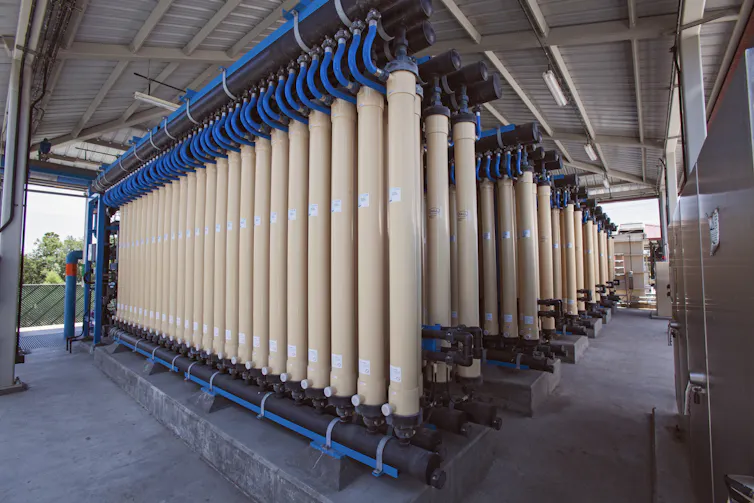 Ranks of filters treat drinking water in California before it is sent to people’s homes. Education Images/Universal Images Group via Getty Images
Bad to drink, even worse to breathe
The timescale and route of exposure of waterborne contaminants matter, too. If stagnant pipes are left unused for a long time, bacteria can build up. Then, when people start a shower or use an outdoor fountain, that bacteria can travel into the air as mist. This poses a different kind of threat than exposure to a chemical pollutant in drinking water because this would lead to bacteria infection.
For example, when there is a large buildup of Legionella spp. , a group of bacteria that can grow in drinking water distribution systems and power plant cooling towers when condensation pools, people who inhale the water vapor can develop Legionnaires’ disease, an acute form of pneumonia. Waterborne pathogens and their associated infections account for billions of dollars in maintenance and healthcare costs annually.
Hazards, risk, and Flint as an example
Moreover, it is important to distinguish what is hazardous and how it could eventually become a human health risk. In the case of Flint, Michigan, lead in a water pipe is a hazard, but as long as the water flowing through it is chemically stable and doesn’t react with lead from the pipes, the immediate risk to human health is low.
In the city’s 2014 water crisis, water from a new source was not chemically treated to reduce its ability to pick up lead from the pipes. By 2016, people had been ordered not to drink the water anymore because it was contaminated with dangerous levels of lead, which can cause neurological problems and impair brain function.
The real questions go beyond just looking at what’s in water, to include what kinds of dangers are there, whether immediate like Legionnaires’ disease or chronic like lead poisoning or cancer. Regulatory standards don’t always address every potential source or type of contamination.
The next time you review your local water report, don’t just look at what is being monitored; consider what may not be on the list at all.
Key Points:
- Drinking water contains naturally occurring minerals and other dissolved substances. A test result’s significance depends in part on the concentration detected.
- Annual water quality reports summarize monitoring results and show how they compare with regulatory standards.
- Researchers are still studying how often some PFAS and other emerging contaminants occur in water, how people are exposed, and how well treatment can remove them.
- Chlorine helps control microbes, and it can also react with organic matter to form byproducts that utilities monitor.
- Water quality can change after treatment. Lead can enter water through plumbing, and bacteria can grow in building water systems and spread through mist.
This article is republished from The Conversation under a Creative Commons license. Read the original article.