Inspiration
By Charles Towne
The humble crayfish is near the bottom of the food chain but it cannot be said that the crayfish is everybody's meat without acknowledging that on the other side of that same coin, everybody is the crayfish's meat.
Imagine if you will that a hunter shoots and wounds an alligator. The large reptile escapes but eventually dies from the hunter's bullet lodged in its skull. For a while the dead 'gator floats, but eventually it sinks to the bottom where the turtles, ordinarily the alligator's prey, move in and begin to feed.
Another smaller alligator joins the feast, rending and tearing the tough hide with powerful jaws opening the carcass to enable the crayfish to begin to move in and feast in earnest.
Thus it is that the crayfish ultimately devours the very top of the food chain, perhaps as unpleasant as it may seem, if the opportunity should by chance present itself, even lord man himself.
Meanwhile, not far away, propelled by sporadic whips of its tail the mosquito larva moves forward in an erratic up and down motion. It is unaware of the hungry minnow that waits there, watching.
Suddenly there is a flash of movement and before the mosquito larva can flee it is seized and a moment later, engulfed.
The minnow has eaten several of the tiny insects but its hunger is rarely satisfied. Hanging there, almost motionless as it pumps water through its tiny gill slits, waiting, always the hunter, it is unaware that it is being watched with rapacious intent.
With patience born of an insatiable appetite the crayfish waits. The little crustacean is, as all of its kind, always hungry and an opportunistic feeder. It can always scavenge the dead but if by chance it should be offered an unwary minnow? It watches the minnow hungrily, hopefully. There is movement. Is it another mosquito larva? Yes. Instantly the minnow is in pursuit. It is so intent on pursuing the tiny larva that it is unaware of the crayfish until it is too late.
The larva too small to interest the crayfish, unaware of the minnow that pursues it swims within an inch of the hungry crustacean with the minnow in swift pursuit, intent only on its prey.
The crayfish attacks and seizes the minnow in those terrible armored pinchers while the mosquito larva escapes under a bit of flotsam.
With rapid thrusts of its tail, the crayfish jets backward and settles near the shore in two inches of water. Immediately it begins to ravenously devour the yet struggling minnow.
The half-grown bullfrog watches with deadly intent and when it is sure, it lunges. Both the crayfish and the yet struggling minnow are instantly engulfed. The bullfrog moves backward and settles, then it swallows, blinks, makes a brushing movement at the corner of its mouth with one forefoot, blinks again and for a moment it relaxes.
To relax can be fatal.
The frog is only about half-grown as is the twenty-four-inch long cottonmouth water moccasin that just so happens to be laying nearby. The snake has seen the frog’s movements and is even now slowly advancing.
As the frog settles down to digest its meal the cottonmouth continues to slowly move closer, ever closer. The snake's movements are subtle, almost fluid as it surreptitiously, in slow starts and stops, closes the distance. When it is sure, it strikes.
It does not utilize its specialized poison apparatus, it seizes the frog in jaws lined with innumerable recurved teeth and immediately throws a loop of its powerful body around its prey. It contracts, squeezing the life-giving air out of the frog’s lungs. Soon, very soon the bullfrog moves no more. Minutes have passed, such a brief moment in time that the crayfish in the frog's gut is yet clinging precariously to life as the snake begins to swallow the frog.
The great blue heron is hunting. It stands very still, all of its concentration on that spot of water.
Actually, it should be said that the heron's attention is on the small garfish that lays there pumping water through its gills. The gar, unaware of the danger above, intently watches a small clump of water hyacinths.
A fingerling bass disappeared into the bit of floating vegetation only moments ago. In its brief lifetime, the gar has already learned that patience rewards the hunter so it cruises, waiting for the bass to leave its have of safety.
Suddenly the garfish is struck a terrible blow. Its first instinct is to flee but somehow its movements are impaired. Its tiny brain screams a series of escape messages but those messages are all confused and to no avail.
Lifted high and shaken until tiny scales and bits of bloody flesh fly in a spray the gar is flipped into the air and seized by its head to begin a dark journey which it will never comprehend.
The great blue heron shakes its head and blinks several times as it swallows, then, bending its long neck it grooms itself with the toes of one foot. It spreads its wings and shakes them, restoring circulation after its hunting vigil. Then it takes several graceful steps and stops again. The foot which was raised in the process of taking that last step slowly descends, barely disturbing the water's surface. The heron is again the hunter.
An errant breeze lifts one of the heron's long crest plumes but this makes no more movement than if it were a leaf disturbed by that same gentle breeze.
Again that long neck un-winds, the head darts down in a blur of movement and that long stiletto beak pierces the water.
A large crayfish is withdrawn to promptly follow the dark path the garfish took only a brief time before.
Noticing a slight movement in the reeds along the shore the heron moves with shadowy grace, intent only on filling the remaining void in its gut.
It approaches the area cautiously.
Even though the water is only a foot deep it is enough to conceal an alligator large enough to include a tough old heron to its diet.
The heron is all hunter, its bright eyes darting this way and that.
The cottonmouth water moccasin lies there in the shallow water at the shoreline. It has eaten the bullfrog and is now searching for a place where it can curl up and digest its meal and perhaps soak up a little sunshine at the end of the day.
The heron has spotted the cottonmouth and decides that this will be a fitting main course to its dinner.
Born of a precision born of instinct and practice the heron thrusts, not out of malice for it knows no such thing. Only with a need driven by hunger, the need to survive does the heron act.
Immediately the snake reacts.
It is interesting to note that the one to react in the hunter/prey relationship seldom does so in time to prevent being eaten.
Writhing and twisting in a violent attempt to escape it reaches back, its jaws agape, those flesh piercing fangs erect.
In a rapid series of movement its jaws open and close spasmodically, the fangs audibly clicking on the heron's beak.
The snake impulsively works muscles that send a golden amber spray of toxic venom splashing into the water at the heron's feet. It continues to struggle, striving mightily to reach the heron's flesh with its fangs but to no avail.
The heron walks up onto the river bank carrying the reptile in its beak.
The struggle might have been different had the snake been seized another three inches lower on its body, then it might have reached the birds head or neck but as it is the outcome is fairly certain.
Casting the snake to the ground the heron swiftly steps on it, pinning it there. Then, as swiftly as the snake’s strike the heron repeatedly strikes, the lethal stabs directed at an equally lethal head.
The snake attempts to strike the foot and leg that hold it down to no avail. Hard scales remarkably similar to those of the snake itself are not very good targets for the specialized, flesh piercing fangs.
Soon the snake lies twitching at the heron's feet, dead, its head demolished, no longer a threat. Only then does the bird begin to swallow its prey.
Twenty minutes later the great blue heron, well sated, is perched on a branch of the old cypress. As the sun drops below the trees the heron clucks contentedly and settles itself, then, blinking drowsily, it tucks its head under one wing and sleeps.
The family of raccoons have left the cavity in the ancient cypress sometime before and not far away a barred owl calls and is shortly answered from the other side of the river by its mate.
Elsewhere, throughout the swamp and the surrounding forest, those creatures that hunt through the night also began to move.
And so the cycle continues, as does the endless story.
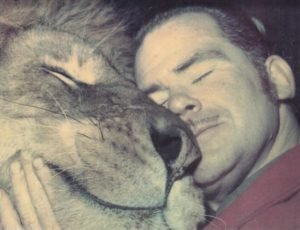 Charles Towne is first and foremost a Christian. An octogenarian, author, journalist, wildlife photographer, naturalist, caregiver, and survivor, his life has been and continues to be, a never-ending adventure filled with possibilities never imagined. He has adopted the philosophy that to Live fully, laugh uproariously, love passionately, and learn like there is no tomorrow, is a formula for a long and joy-filled life.