It’s officially spring, and almost like clockwork, several seasonal caterpillars have begun to emerge from our trees…and may have found their way onto our walls, benches, and well, just about everywhere. While their presence may be a nuisance to some, these caterpillars are (mostly) harmless and serve as an important food source for birds, bats, lizards, and other animals.
Learn more about the springtime caterpillars below.
Tussock moth (Orgyia spp.)
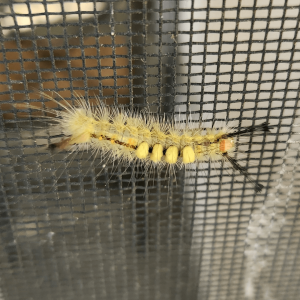 Tussock moth caterpillar (Credit: Jackie Lebouitz, UF/IFAS)
Well, if it isn’t everybody’s favorite caterpillar, the tussock moth. Okay, perhaps that’s a bit misleading. This caterpillar is the cause of many complaints, as it tends to crawl on just about any structural surface before preparing to pupate, or form a cocoon. They can also be incredibly numerous, with occasional outbreaks of hundreds congregating in urban areas. There are three common species found in Florida: the fir tussock moth (Orgyia detrita), definite tussock moth (Orgyia definita), and white-marked tussock moth (Orgyia leucostigma).
| Description: |
- Bright red head
- Four tufts of hair on the back, called “tussocks”
- Several stinging, or urticating, hairs along the body
- Two thick “hair pencils” protrude from the front end and one from the back end
- Up to 4 cm in length
|
| Host plants: |
- Orgyia detrita
- Orgyia definita
- Willow, oak, maple, hackberry, and birch
- Orgyia leucostigma
- Polyphagous (eating many different kinds of plants)
- Some common hosts include oak, cherry, hackberry, and willow
|
Read more here.
Oak leafroller (Archips semiferanus)
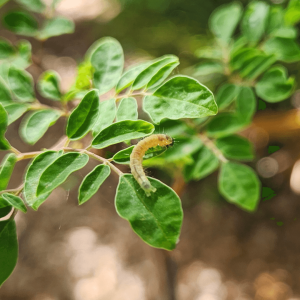 Oak leafroller caterpillar (Credit: Jackie Lebouitz, UF/IFAS)
These green caterpillars often pop up in our parks and natural areas, occasionally surprising unaware passersby. Commonly called “inchworms,” oak leafrollers are sometimes found dangling from the lower canopy of oak trees on a thin strand of silk. They earned their nickname through their distinct movement style, which is a slow, repetitive looping. Coincidentally, they often are up to about an inch in length.
Oak leafrollers use their silk to roll up oak leaves before feeding on them from the inside. This also helps them hide from potential predators. Although they feed on oak trees, they very rarely cause enough damage to warrant chemical intervention. In fact, there are many natural predators that help keep populations in check! Caterpillars will feed for about a month before dropping to the ground, pupating, and emerging as similarly small moths in the late spring and summer months.
| Description: |
- Green body
- Black head
- Up to 2.5 cm in length
|
| Host plants: |
|
Another similar species found in Florida is the oak leaftier (Croesia semipurpurana). Read more about both species here.
Wooly gray moth (Lycia ypsilon)
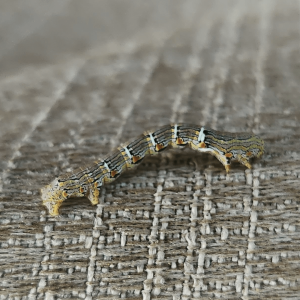 Wooly gray moth caterpillar (Credit: Jackie Lebouitz, UF/IFAS Extension)
The caterpillar of this moth greatly resembles a twig, but upon closer look, it’s actually quite colorful! With shades of brown, yellow, red, white, and black, it sure is a beauty to behold. The wooly gray moth, along with the oak leafroller, belong to the family Geometridae, commonly referred to as the geometer moths. This species, like many other geometer moth caterpillars, moves in a looping pattern.
| Description: |
- White and black spotted head
- Black, white, and brown parallel lines along length of body
- White stripes present on middle body segments
- Spiracles (breathing tubes) accented by red blotches
- Yellow markings throughout
- Up to 4 cm in length
|
| Host plants: |
- Polyphagous on several species of woody plants
- Some common hosts include apple, cherry, and oak
|
Read more here.
Echo moth (Seirarctia echo)
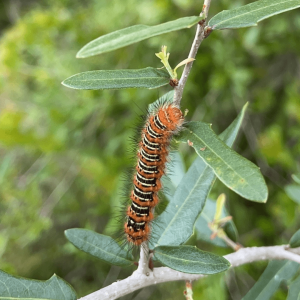 Echo moth caterpillar (Credit: Zahir Ringgold-Cordes, UF/IFAS Extension)
Arguably one of the most iconic caterpillars in Sarasota County, the echo moth can commonly be found in parks and natural areas where its preferred host plants are abundantly available. It is one of the few caterpillars that can tolerate eating the toxic coontie plant, along with the Atala butterfly. However, it will feed on a wide range of woody plants. Although they tend to peak in the spring, the echo moth can be found throughout the year.
While their hairy bodies may look intimidating, echo moth caterpillars are not reported as venomous. However, handling them may result in contact dermatitis for some sensitive individuals. They are also toxic when ingested, not that any of you are considering it. At least, I really hope not.
| Description: |
- Bright orange body and head
- Horizontal black and yellow stripes across width of body
- Orange and black hairs protrude from raised orange sections of body
- Up to 4.5 cm in length
|
| Host plants: |
- Polyphagous on several species of woody plants
- Some common hosts include coontie, cabbage palm, crotons, lupine, oaks, and persimmon
|
Read more here.
Management
Given the seasonal nature of these caterpillars, it’s best to leave them be. If you really need to control them, consider using a Bt spray formulated for caterpillars. Make sure to follow the directions on the label and apply the spray to their food source (host plants outlined above), as it must be ingested to work. Caterpillars that remain relatively still on structures are likely too close to pupation and no longer need to eat. While Bt spray will not be effective in treating them, spinosad may work as a contact insecticide.
If they make their way into the home, you can remove them by using a broom to gently sweep them into a dustpan, then relocate them back outside. Make sure to check around the foundation, garage, windows, and doors for possible points of entry, then seal them up to prevent more caterpillars from coming inside.
Cocoons can be removed, when needed, by using tweezers. Make sure to wear proper protection when doing so, as some caterpillars may shed stinging hairs when disturbed.
If you have a caterpillar concern, consider using our online insect identification service to receive an identification and management suggestions.
Key Points:
- Several caterpillar species commonly emerge in spring, including tussock moths, oak leafrollers, wooly gray moths, and echo moths
- Most caterpillars are harmless, though some may cause minor skin irritation if handled
- They play an important ecological role as a food source for birds, bats, and other wildlife
- Chemical control is rarely necessary; natural predators help regulate populations
- Simple management options include sweeping them away, sealing entry points, or using targeted treatments like Bt when needed