In Summary:
A Texas A&M University researcher argues that the National Flood Insurance Program creates different forms of risk for wealthy and low-income homeowners. The analysis highlights how rising premiums, repeated flood losses, and limited affordability leave many vulnerable families without adequate protection. The author calls for reforms that better align flood insurance costs with risk while expanding assistance for households that cannot afford coverage.
*****
Anyone who has been through a flood or hurricane knows the scene: waterlogged furniture piled on curbs, gutted homes with mold creeping up the walls, families displaced for months. But the recovery isn’t the same for everyone.
While federal flood insurance subsidizes risky coastal and waterfront development for wealthier homeowners by lowering the cost of living in these areas, many low-income households in flood-prone areas remain stuck with risky properties and little help.
Related: Build your hurricane emergency kit now, Orange County officials stress.
As a disaster recovery researcher, I’ve witnessed how perverse incentives create different cycles of vulnerability across income levels. The problem with federal disaster insurance today isn’t just about subsidizing wealthier coastal homeowners – it’s equally about leaving low-income households systematically underinsured without resources to either protect themselves or leave.
Federal flood insurance’s moral hazards
The National Flood Insurance Program was established by Congress in 1968 to provide affordable flood insurance to the public while encouraging floodplain management.
Communities that participate in the program are required to adopt regulations to reduce flood risk in their areas for their residents to qualify. The insurance policies, around 4.7 million today, are purchased either through the program or through insurance companies, but are administered and underwritten by the Federal Emergency Management Agency, the nation’s disaster response agency. When the policy cost is lower than the risk, the property is being subsidized by the federal program.
The National Flood Insurance Program did succeed in providing accessible insurance for many people, but it also produced a “moral hazard,” where people take on risk without bearing its full consequences. What’s less well understood is that this operates differently by income level.
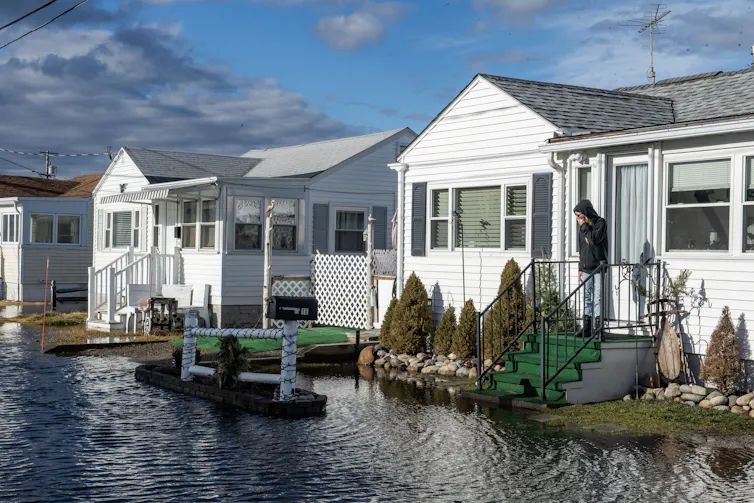 Water rises toward homes in Hampton, New Hampshire, on Jan. 10, 2024, after a storm with high winds, heavy rain and high seas. Joseph Prezioso/AFP via Getty Images
FEMA is currently working to adjust flood insurance prices to more closely match each property’s actual risk. The program’s Risk Rating 2.0 changes, which began in 2021, aimed to transition policies to full-risk pricing for everyone. The annual premium increases are capped by law at 18% for primary residences, so full-risk pricing won’t be fully reached until around 2037, according to federal estimates.
But there’s another, less visible problem: Federal flood insurance already wasn’t affordable for many people.
In low-income neighborhoods, more than 90% of households are estimated to be underinsured, and their uninsured losses when they experience flooding often exceeds 20% of their annual income.
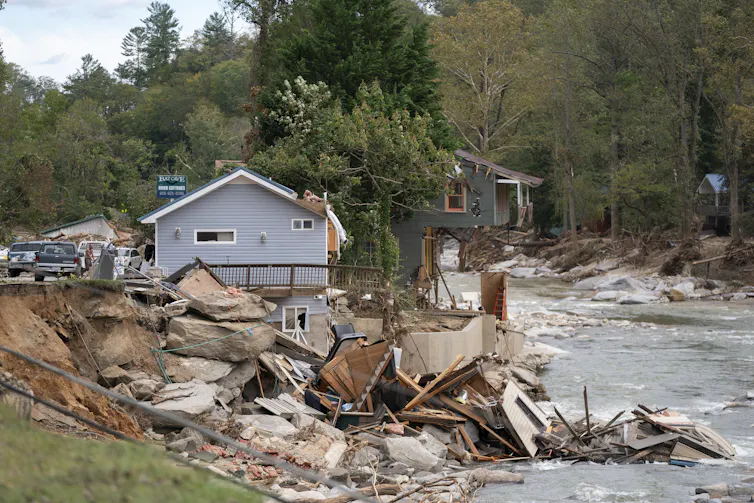 Many homes along creeks and rivers in western North Carolina were devastated by flooding from the remnants of Hurricane Helene in 2024. Sean Rayford/Getty Images
Many families are unable to afford federal flood insurance premiums – only 37% of all policyholders pay less than $1,000 per year, according to FEMA. Instead, homeowners may skip insurance, gambling that disasters won’t strike. When floods do occur, these households can face catastrophic uninsured losses.
Homeowners and renters may also choose federal flood insurance plans with lower premiums but that provide less coverage in a disaster, and even those plan costs can be high.
Because the federal flood insurance program doesn’t specifically help those who cannot afford premiums, this creates a structural trap: Wealthier homeowners receive government-subsidized insurance support for risky properties, while many lower-income households fall outside the system entirely.
Severe repetitive loss homes
FEMA’s repetitive loss properties also tell a story. Roughly 1% of National Flood Insurance Program properties are considered “severe repetitive loss” homes – those with multiple flood events over a 10-year period. Historically, those properties have accounted for nearly 30% of all claim payments.
Low-income households that can’t afford to move can end up experiencing repeated losses, depleting their savings and leaving them facing persistent instability.
My research in Puerto Rico has shown how this repeated rebuilding deepens vulnerability, trapping families in a cycle where each disaster pushes them further into poverty and housing insecurity rather than allowing them to recover, what sociologists call “downward mobility.”
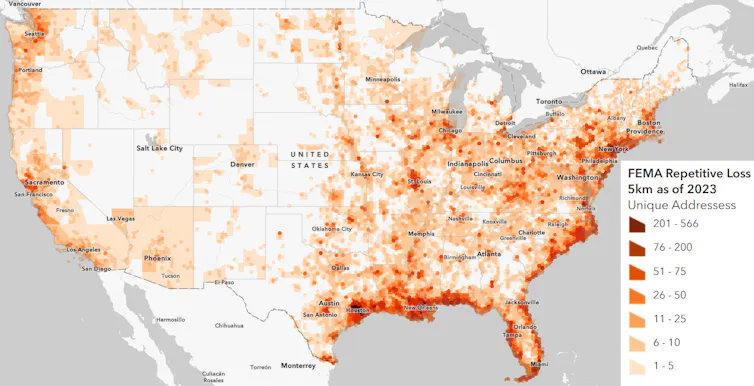 A National Flood Insurance Program map shows the number of repetitive loss properties within a 5 kilometer radius as of 2023. The highest rates are along the Gulf and Atlantic coasts, as well in some inland river valleys. FEMA with Esri, TomTom, Garmin, FAO, NOAA, USGS, EPA, USFWS
Breaking both cycles
Addressing these moral hazards requires different responses.
Income-based assistance programs such as FEMA’s Flood Mitigation Assistance grants can help ensure families aren’t priced out of safety. For example, the upfront cost of home improvements that could reduce a home’s flood exposure, such as elevating the home or flood-proofing the property, can be too high for many people to afford, but assistance programs can help.
Voluntary buyout programs can also be effective in helping low-income homeowners relocate from risky properties – if those programs offer fair market value, meaningful relocation support and timely implementation. Prolonged, underfunded buyout processes can be harder for households with less cash available to manage.
The National Flood Insurance Program has another ongoing problem as more people move to flood-risk areas and as property values and storm damage rise. By early 2025, the program was about $22.5 billion in debt to the U.S. Treasury, even after Congress canceled $16 billion in debt in 2017. That debt accumulates $1.7 million in interest daily, costs borne by current and future policyholders through their premiums.
I believe fixing federal flood insurance will require an approach that accurately prices risk for those who can afford it while providing genuine assistance to low-income homeowners, for example, through affordable insurance, aid for projects that reduce homes’ vulnerability, or equitable buyouts.
The water will come again. Flooding will strike both the insured mansions on the coasts and the uninsured mobile homes inland. The question is whether U.S. policies will continue to leave different forms of moral hazard for the rich and the poor, or whether the government will finally align the country’s disaster response with reality.
Key Points:
- The National Flood Insurance Program was created to provide affordable flood insurance while encouraging floodplain management.
- Many low-income households remain uninsured or underinsured because they cannot afford flood insurance premiums.
- FEMA estimates that more than 90% of households in some low-income neighborhoods may be underinsured against flood losses.
- Severe repetitive-loss properties account for a disproportionate share of flood insurance claims and recovery costs.
- The author argues for expanded mitigation assistance, affordable insurance options, and equitable buyout programs to reduce future flood risks.
This article is republished from The Conversation under a Creative Commons license.