From 2020 to 2024,
Florida’s population grew by 8.5%, from 21.6 million to 23.4 million.
This is nothing new: The state’s warm weather, amenities that include world-class golf courses and beaches, and lack of income tax have long attracted newcomers, so Florida often leads the U.S. in population growth.
Related: Committee launches campaign opposing Florida's proposed property tax amendment.
But recent data suggests that population growth may be slowing.
As demographers – social scientists who specialize in population change – we evaluated the current trends in the Sunshine State.
Property tax amendment on the ballot
Demographics have political implications, and at the moment, Florida’s government is relying on continued growth.
In early June 2026, the state Legislature approved a ballot initiative for November aimed at reducing property taxes for homeowners. The proposed amendment to the state constitution would expand the homestead tax exemption, not including school taxes, for current Florida homeowners on their primary residence. The exemption would start at US$150,000 in 2027, then ramp up to $250,000 in 2028 and be adjusted for inflation after that.
In other words, the tax collector would deduct the exempted amount from the assessed value of a homesteaded property, and the property tax rate would then be applied to that lower number.
Supporters of the tax cut argue that reduced tax revenue would be recouped by the continued arrival of new residents. These newcomers would be buying homes at the usual property tax rates, with an exemption of only $50,000. After four years, that would increase to $250,000. It’s also possible that the proposed tax cuts might attract new residents.
If Floridians vote for this exemption in November, the state’s continued population growth would be vital to maintaining local and state government budgets.
The state Legislature also recently approved a new congressional map for 2026. Florida Gov. Ron DeSantis says this new map is needed to address “malapportionment” and uneven migration patterns within the state since 2020. Before redrawing the districts in April 2026, the governor had repeatedly said that the state was shorted a congressional representative because some areas had more population growth than others.
Is Florida still growing?
To determine whether Florida’s population is still growing, we used the Census Bureau’s components of change dataset. The Bureau provides annual estimates of population size and the factors responsible for changes: births, deaths, domestic in-migrants, domestic out-migrants, immigrants and emigrants.
From this data, we estimated the annual growth rate for Florida and its 67 counties, along with the contribution of three factors: natural increase, meaning the difference between the number of births and deaths; the net domestic migration, which is the difference between the number of people moving in from other states and moving out; and net immigration, meaning the difference between the number of immigrants and emigrants.
The impact on Apopka and Orange County
Apopka
For Apopka, a statewide slowdown in population growth could have mixed effects. The city has spent much of the past decade planning for rapid residential development, with thousands of approved but unbuilt housing units still in the pipeline. If fewer people move to Florida, the pace of construction could moderate, easing pressure on roads, schools, and utilities. At the same time, slower development could reduce building permit revenue, impact fees, and other growth-related income that have helped fund infrastructure improvements. That shift comes as city leaders are already grappling with rising operating costs and considering a property tax increase in the proposed FY2027 budget.
Orange County
For Orange County, slower population growth could complicate long-term financial planning. County government has historically relied on a growing tax base to help pay for expanding services, transportation projects, and public safety needs. If growth continues to cool while voters approve a larger homestead exemption this November, officials may have fewer new taxpayers to offset the resulting reduction in property tax revenue. At the same time, slower migration could reduce some of the demand driving traffic congestion, housing construction, and infrastructure expansion, giving county leaders an opportunity to focus more on maintaining existing assets rather than continually building new ones.
Our data shows that Florida’s population was still growing in 2025, but at an annual rate of just 0.9%. This pales in comparison to Florida’s peak growth rate of 2.5% in 2022 and is also much lower than the five years prior to the COVID-19 pandemic.
Three demographic factors explain this change. First, domestic migration has slowed to a trickle. In 2025, just 22,000 more people moved to Florida from other states than moved out. For comparison, the annual average during the pandemic, from 2020 to 2022, was around 208,000. While no single shift can fully explain this slowdown, rising housing costs in the state may be a culprit. Predicted increases in both property insurance rates and severe weather may also be discouraging newcomers from moving to Florida.
Second, since 2020, more Floridians are dying than being born each year. While this natural decrease is not unique to Florida, its social, economic and demographic impacts may be more pronounced if the state is no longer a migrant magnet.
Third, immigration to Florida from abroad dropped sharply in 2025, a year that saw new anti-immigration policies nationally and within Florida. Plummeting immigration is concerning, as our data suggest it has been the largest contributor to Florida’s growth since 2023.
Where is Florida still growing?
While the currently available data does not indicate the exact changes in the types of people moving in and out of Florida, we can find clues by looking at county trends.
Florida’s peak growth rates occurred following DeSantis’ 2021 decision to lift pandemic-era restrictions. During that time, growth was most concentrated in Florida’s retirement destinations.
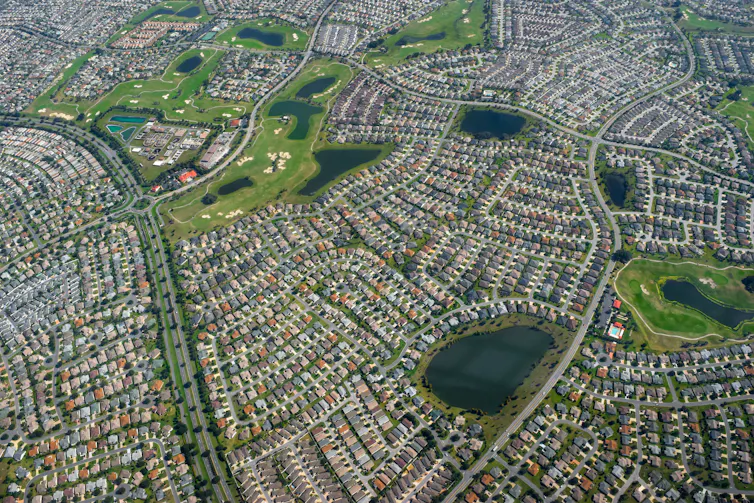 The Villages is a popular retirement destination that saw a huge population boom during the pandemic, but its growth has since slowed significantly. Michael Warren/iStock via Getty Images Plus
Sumter County, home to The Villages, the nation’s largest retirement community, experienced an astonishing 7.4% growth rate in 2022. Gulf Coast counties with large retiree populations, such as Collier County, where Naples is located, also grew rapidly at 3.6%.
Post-pandemic, these same places saw growth rates slow. Sumter County’s rate fell to 2.3%, while Collier County grew by just 0.1% in 2025.
Some Florida counties are still growing rapidly. St. Johns County, located in the Jacksonville metro area, led all counties in the state with a 3.9% growth rate. St. Johns is suburban, with a high percentage of families with children and some of the best-rated schools in Florida. This suggests that this growth may be due less to retirees and more to families with children moving in from other parts of the state.
Marion County, home to exurban Ocala about an hour north of Orlando, was the only county to experience higher growth rates in 2025 than in 2022. Last year, Marion County grew by 3.4%. Notably, the median home value in Marion County was around $275,000, while the statewide median home price was roughly $397,000. Growth in places like Ocala suggests that rising housing costs are indeed shaping Florida’s demographic future.
Florida has long thought of itself as a state that catalyzes growth, a fact backed by its booming population. However, our calculations show that population growth in Florida, particularly from out-of-state migrants, has nearly stopped.
What this means for the future is unclear. The parts of the state growing fastest now were not the places growing fastest earlier this decade, and other counties may surge between now and 2030. Regardless, Florida’s population slowdown will be closely watched by its government and demographers.
Key Points:
- Florida's annual population growth has slowed from a peak of 2.5% in 2022 to about 0.9% in 2025.
- Researchers cite slower domestic migration, natural population decline and reduced immigration as the primary reasons.
- The slowdown comes as voters prepare to consider a constitutional amendment expanding Florida's homestead property tax exemption.
- Fastest-growing areas have shifted from retirement communities to more affordable, family-oriented counties such as St. Johns and Marion.
- Researchers say the long-term effects of Florida's demographic shift remain uncertain but could influence housing, infrastructure and government finances.
This article is republished from The Conversation under a Creative Commons license.