By Serena Dyer, De Montfort University
Poets, philosophers, and scientists have all struggled to define love. But when words fail to express our feelings, lovers have turned to gifts throughout history. Whether given as part of a public romantic gesture or in the quiet intimacy of a private moment, romantic gifts are a longstanding staple of romantic expression.
In 2024, Valentine’s gift-giving is a commercial goldmine for retailers. Popular choices for a romantic gift might include an evening out, a heart-shaped box of chocolates, or a classic bunch of red roses. However, research shows that if you really want to impress your sweetheart, jewelry and fashion accessories are the best options.
It is estimated that $6.5 billion will be spent on Valentine’s Day bling in the US alone in 2024, while a further $3 billion will be spent on clothing, such as lingerie.
This commercialization of love may seem like a modern phenomenon of our capitalist age, but jewelry and fashion accessories have been popular tokens of love for centuries.
I’m a fashion historian. Here are five historical ways you could show that yours is a love for the ages with a gift of jewelry or fashion this Valentine’s Day.
1. Sexy underwear, the Georgian way
Today, corsets are associated with titillating lingerie. The corset’s predecessor stays (fully boned lace bodices) were just a functional part of everyday dress for the Stuarts and Georgians, but they could still have romantic features.
The busk was a long piece of wood that slipped inside a channel at the front of the stays. Its practical purpose was to keep the front of the garment straight, but people also found more intimate and romantic uses for it.
 A 17th-century French busk with the inscription: ‘Until I see you again … my love is pure’. Met Museum
Engraved with love poems, depictions of hearts, and sometimes even verses euphemistically referring to orgasms, these busks were often given as romantic gifts. Positioned between the breasts, the engraved rhymes often expressed jealousy for the busk, which got to rest in the recipient’s cleavage intimately.
One busk from 17th-century France was engraved: “He enjoys sweet sighs, this lover / Who would very much like to take my place.”
2. Lovers’ eyes
Georgian lovers did not always conceal their love tokens in their underwear. Eye miniatures, also known as lovers’ eyes, were rings, brooches, or pendants decorated with miniature paintings of a romantic partner’s eye. These were gifted between lovers as a wearable symbol of their love.
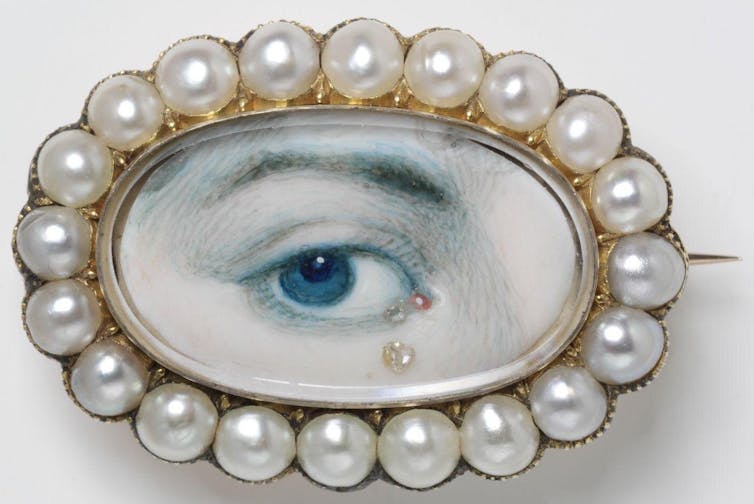 An eye miniature from the early 19th century. Victoria and Albert Museum, CC BY-NC
The Bible says that the eyes are the window to the soul, and the lover’s eye was considered an incredibly intimate form of portrait. Yet it was also very secretive and caused tantalizing gossip. Much speculation ensued about who was wearing whose eye.
3. Lockets
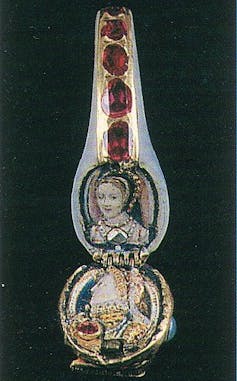 Elizabeth I’s locket ring, known as the Chequers Ring. Ann Longmore-Etheridge/flickr
Another popular way of keeping a secret lover close to the heart was the locket.
Early lockets often expressed religious devotion and familial connection rather than romantic love. Queen Elizabeth I, for example, wore a locket ring containing portraits of herself and her mother, Ann Boleyn (although some historians argue it could be her stepmother, Catherine Parr).
With the rise of mass manufacture in the 19th century, lockets became a cheaply available and widespread love token for the masses.
The new technology of photography also meant that placing a picture of your loved one inside the locket did not require the expensive commissioning of a portrait painter.
4. Hair jewelry
The practice of cutting a lock of your lover’s hair and wearing it in a locket close to your heart was historically widespread, but the Victorians took this trend even further.
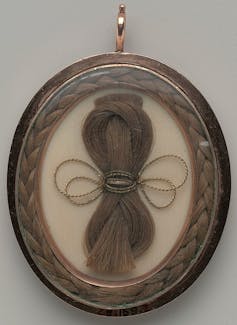 Hair locket from 1795. Metropolitan Museum of Art, CC BY-SA
Hair jewelry – ornaments made from strands of a human hairy popular in 19th- – was incrediblcentury Britain.
While there were also commercial hair jewelry makers, some women crafted rings, bracelets, and watch chains out of their lover’s hair at home. Elegant Arts for Ladies, a book containing instructions for crafts that women might try at home, was published in 1856 and even contains instructions for making earrings out of your lover’s hair.
Professional hair-work services came under increasing suspicion in the 19th century. Customers send in the hair of their lover or family member, expecting it to be crafted into a beautiful keepsake. Yet, with increasing commercial demands, some manufacturers turned to mass production, and the item returned was sometimes fraudulently made from a stranger’s hair.
5. Posey rings
Perhaps the most timeless of all wearable tokens of love is the posey ring. These simple gold bands, engraved with a romantic inscription, were consistently popular from Medieval times. Their name comes from the French word poésy (poetry), referring to the words engraved inside.
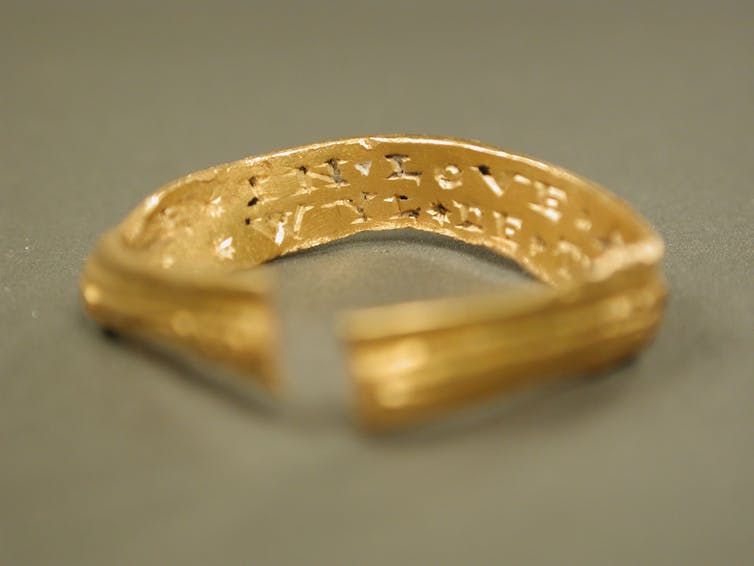 A 16th-century gold posy ring was found in Yorkshire. The Portable Antiquities Scheme, CC BY-SA
The inscriptions in these rings were often taken from published compendiums of sayings, such as The Mysteries of Love or the Arts of Wooing, published in 1658. Sometimes, these inscriptions were touching and romantic, but often, they had religious overtones, such as a 17th-century example engraved with: “Fear God and love me.”
Romantic bling remains a timeless choice for a Valentine’s gift, and the posey ring is still alive and well in the modern wedding band. However, it is doubtful that the wooden busk and hair-work jewelry will return in fashion soon.
This article is republished from The Conversation under a Creative Commons license.