By Katelyn Colley, Interning Correspondent for The Apopka Voice
This summer, Apopka’s Hope Community Center officially began its LGBTQ+ immigrant rights program. The program aims to support members of both the queer and immigrant communities as they navigate the social crossroads these two groups create. Through advocacy, counseling, cultural activities, and documentation help, the HCC has made a place of sanctuary for people who have long been underserved in Central Florida.
Andrea Montanez, who founded the program in June, gained inspiration from her own life experiences. As a Colombian transgender woman, Montanez noticed a lack of support groups for people like her in the local area.
“As far as I know, this program is the first of its kind in Central Florida,” said Montanez. “We welcome all people from different backgrounds and provide them a safe space here.”
The most recent meeting had around 30 people, which has doubled since its start. Although the group is primarily Latinx due to its location in Apopka, there have also been members from the Asian, Italian, and British communities. The program welcomes all adults and minors with parental consent.
Education and awareness have been an increasingly important part of the group’s mission as recent political shifts threaten to limit LGBTQ+ opportunities.
“Right now, lawmakers are trying to cut off Medicaid for transgender people in Florida and the medical procedures they need,” said Montanez. “This puts at least 9,000 transgender people in Florida at risk, which is why it is so important that we rally for them.”
Felipe Sousa-Lazaballet is the executive director for the HCC and also noted how important the program was for serving the Apopka community right now. Sousa-Lazaballet was born in Brazil and immigrated to Florida at 14. Now, he lives his life as a proud immigrant and gay man and hopes to give back to each of these communities.
“Queer immigrants are facing both social and legislative discrimination at the same time,” said Sousa-Lazaballet. “At the Hope Community Center, we create opportunities for these people as Apopka grows and deals with recent anti-LGBT sentiments in the state.”
Montanez and Sousa-Lazaballet discussed the stereotypes that often come with being an LGBTQ+ immigrant, making an already potentially difficult situation even harder. This also ties into Machismo culture, which includes traditional attitudes of misogyny and strict familial roles in Latinx communities.
“For Latinos, family is really important, as well as the roles that historically come with it,” said Sousa-Lazaballet. “I believe that love can overcome those stereotypes, and we can change this community. The LGBTQ+ immigrant rights program allows these people to be their true, authentic selves.”
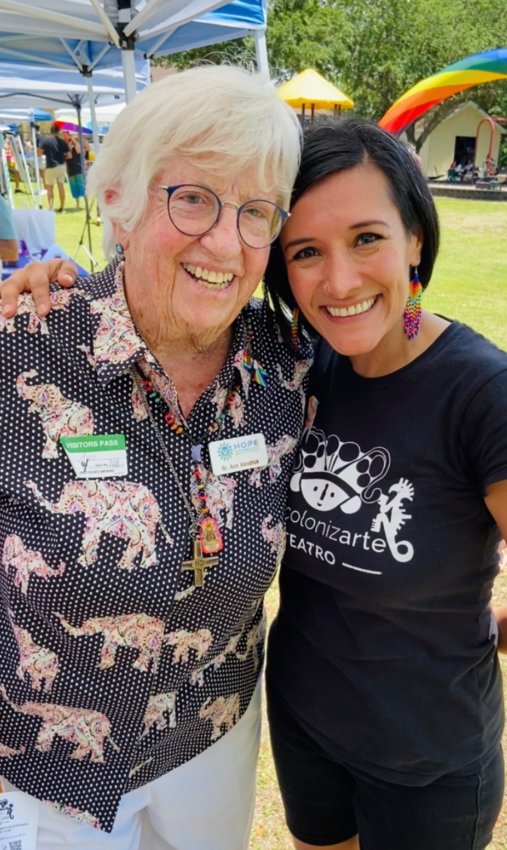
Sister Ann Kendrick and Nadia Garzón.
One HCC volunteer, who is particularly familiar with these traditional attitudes, is Nadia Garzón. Garzón first came to HCC as an actress performing a play at the organization’s center. She later launched her theater organization, Descolonizarte Teatro, which partners with HCC to create safe spaces for queer and immigrant people wanting to pursue the arts. As a member of the LGBTQ+ immigrant rights program herself, Garzón has seen firsthand the positive effect support groups have on Apopka residents.
“It is such a beautiful, welcoming, and much-needed group,” said Garzón. “We don’t have many spaces to explore our identities, especially apart from Machismo culture. This is a global issue found in many cultures, but it seems that patriarchal ideas can sometimes tie into homophobia and transphobia.”
Garzón noted how queer immigrants often face backlash from both parts of their identity. According to Garzón, immigrants are often seen as uneducated and thugs, while LGBTQ+ people are accused of trying to influence children to fit their lifestyles.
“These people are being reduced to society’s expectations of them, but that’s not what should define the community,” said Garzón. “The HCC program is important for promoting visibility to combat these stereotypes.”
The program’s monthly meetings will continue to expand in partnerships and events for its members. As Apopka welcomes new communities and cultures, the Hope Community Center may be the safe haven local queer immigrants always needed.
“The one thing I want people in our community to know is that this program exists; we exist, and we are present,” said Garzón.