By James B. Blasingame, Arizona State University
It turns out that the title had been removed from the library’s shelves due to a complaint, and in compliance with Florida House Bill 1069, it had been removed from the library indefinitely. Kerouac’s quintessential chronicle of the Beat Generation in the 1950s, along with hundreds of other titles, was not available for students to read.
Gov. Ron DeSantis signed the bill into law in July 2023. Under this law, if a parent or community member objected to a book on the grounds that it was obscene or pornographic, the school had to remove that title from the curriculum within five days and hold a public hearing with a special magistrate appointed by the state.
On Aug. 13, 2025, Judge Carlos Mendoza of the U.S. Middle District of Florida ruled in Penguin Random House v. Gibson that parts of Florida HB 1069 are unconstitutional and violate students’ First Amendment right of free access to ideas.
The plaintiffs who filed the suit included the five largest trade book publishing houses, a group of award-winning authors, the Authors Guild, which is a labor union for published professional authors with over 15,000 members, and the parents of a group of Florida students.
Though the state filed an appeal on Sept. 11, 2025, this is an important ruling on censorship in a time when many states are passing or debating similar laws.
I’ve spent the past 26 years training English language arts teachers at Arizona State University, and 24 years prior to that, teaching high school English. I understand the importance of Mendoza’s ruling for keeping books in classrooms and school libraries. In my experience, every few years, the books teachers have chosen to teach come under attack. I’ve tried to learn as much as I can about the history of censorship in this country and pass it to my students, in order to prepare them for what may lie ahead in their careers as English teachers.
Legal precedent
The August 2025 ruling aligns with established legal precedent regarding censorship. Over the years, U.S. courts have established that obscenity can be a legitimate cause for removing a book from the public sphere, but only under limited circumstances.
In the 1933 case of United States v. One Book Called Ulysses, Judge John Munro Woolsey declared that James Joyce’s classic novel was not obscene, contradicting a lower court ruling. Woolsey emphasized that works must be considered as a whole, rather than judged by “selected excerpts,” and that reviewers should apply contemporary national standards and think about the effect on the average person.
In 1957, the Supreme Court further clarified First Amendment protections in Roth v. United States by rejecting the argument that obscenity lacks redeeming social importance. In this case, the court defined obscenity as material that, taken as a whole, appeals to a prurient – that is, lascivious – interest in sex in average readers.
The Supreme Court’s 1973 Miller v. California decision created the eponymous Miller test for jurors in obscenity cases. This test incorporates language from the Ulysses and Roth rulings, asking jurors to consider whether the average person, looking at the work as a whole and applying the contemporary standards in their community, would find it lascivious. It also adds the consideration of whether the material in question is of “serious literary, artistic, political, or scientific value” when deciding whether it is obscene.
Another decision that is particularly relevant for teachers and school librarians is 1982’s Island Trees School District v. Pico, a case brought by students against their school board. The Supreme Court ruled that removing books from a school library or curriculum is a violation of the First Amendment if it is an attempt to suppress ideas. Free access to ideas in books, the court wrote, is sacrosanct: “If there is any fixed star in our constitutional constellation, it is that no official, high or petty, can prescribe what shall be orthodox in politics, nationalism, religion or other matters of opinion.”
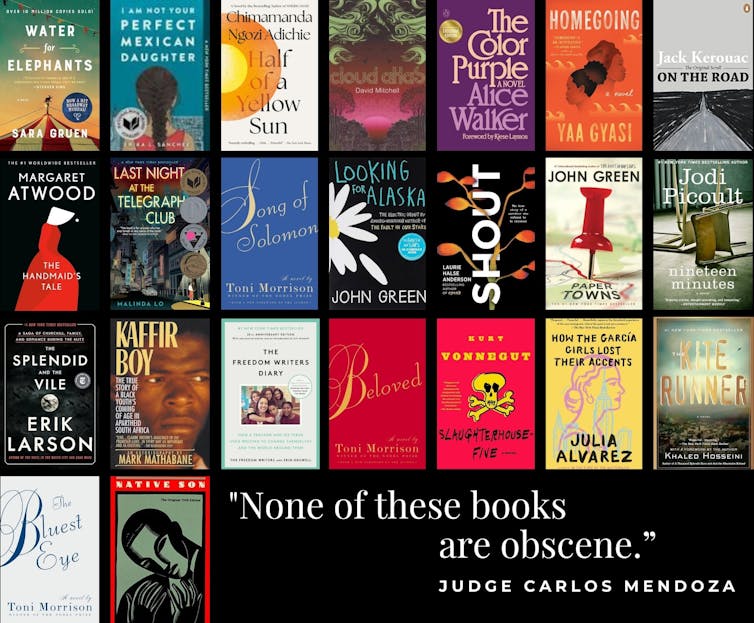 These 23 books were removed from Florida school libraries under Florida HB 1069. In his ruling in Penguin Random House v. Gibson, Judge Carlos Mendoza named them and stated, ‘None of these books are obscene.’ Illustration by The Conversation
What this ruling clarifies
In his ruling in August 2025, Mendoza pointed out that many of the removed books are classics with no sexual content at all. This was made possible in part by the formulation of HB 1069. The law allows anyone from the community to challenge a book simply by filling out a form, at which point the school is mandated to remove that book within five days. In order to put a book back in circulation, however, the law requires a hearing to be held by the state’s appointed magistrate, and there is no specified deadline by which this hearing must take place.
Mendoza did not strike down the parts of HB 1069 that require school districts to follow a state policy for challenging books. In line with precedent, he also left in place challenges for obscenity using the Miller test and with reference to age-appropriateness for mature content.
The Florida Department of Education argued that HB 1069 is protected by Florida’s First Amendment right of government speech, a legal theory that the government has the right to prevent any opposing views to its own in schools or any government platform. Mendoza questioned this argument, suggesting that “slapping the label of government speech on book removals only serves to stifle the disfavored viewpoints.”
What this means for schools, in Florida and across the US
In the wake of Mendoza’s decision, Florida schools are unlikely to pull more books from the shelves, but they are also unlikely to immediately return them. Some school librarians have said that they are awaiting the outcome of the appeal before taking action.
States with similar laws on the books or in the works will also be watching the appeal.
Some of these laws in other states have also been challenged, with mixed outcomes. The U.S. Court of Appeals for the 5th Circuit already struck down Texas’ appeal of a ruling against Texas House Bill 900. And parts of an Iowa bill are currently being challenged in court.
But the NAACP’s lawsuit against South Carolina Regulation 43-170 was dismissed on Sept. 8, 2025. And Utah’s House Bill 29 has not yet faced a challenge in court, though it could be affected by the outcomes of these lawsuits in other states.
This article is republished from The Conversation under a Creative Commons license.
Key Points:
-
Local impact in Orange County – An Orange County high school student’s attempt to check out “On the Road” revealed that the book, along with many others, had been pulled from library shelves under Florida House Bill 1069.
-
How HB 1069 worked – The law required schools to remove a challenged book within five days if a parent or community member claimed it was obscene or pornographic, with no deadline for the state’s special magistrate to hold a hearing to decide whether it could return.
-
Federal court pushback – In August 2025, Judge Carlos Mendoza ruled that key parts of HB 1069 are unconstitutional in Penguin Random House v. Gibson, finding that the law violated students’ First Amendment right to access ideas and that the challenged books were not obscene.
-
Long legal history of protecting books – The decision draws on decades of precedent, including the Ulysses, Roth, Miller, and Pico cases, which collectively stress that works must be judged as a whole, that “obscenity” is narrowly defined, and that officials cannot remove books simply to suppress disfavored viewpoints.
-
Uncertainty going forward – With the state appealing the ruling, many school districts, including Orange County, are caught in limbo: unlikely to remove even more books right now, but also hesitant to quickly restore titles until courts deliver a final answer.