By Neha Gour, Ed Maibach, and Luis Ortiz, George Mason University
In Summary:
The rapid expansion of data centers is transforming communities across the United States as demand for artificial intelligence, cloud computing, and digital services continues to grow. Researchers examining the industry's impact identified five major concerns for residents living near data centers: air quality, water consumption, noise pollution, land-use changes, and higher energy costs. While experts say many of these impacts can be reduced through better planning and cleaner energy sources, they argue that community health must remain a priority as digital infrastructure expands.
*****
Every internet search, streamed video, and AI-generated response depends on a data center somewhere. Driven by rapid growth in artificial intelligence, cloud computing, and cryptocurrency, data centers have become the backbone of the modern digital economy. Though their primary role is to enable virtual and remote experiences, data centers are physical buildings in real communities across the nation and around the globe.
Related: Florida cities, counties warn DeSantis property tax plan could slash local revenues.
The United States hosts more than 4,000 data centers – more than any other country. The U.S. Department of Energy expects that, taken together, U.S. data centers will consume up to 12% of U.S. electricity by 2028. In 2023, data centers consumed about 4.4% of total U.S. electricity – roughly 176 terawatt-hours.
In the U.S., Virginia has more data centers than any other state – over 600, two-thirds of which are in the northern Virginia suburbs of Washington, D.C. In 2023, the state’s data centers consumed about 26% of Virginia’s total electricity supply – a higher share than in any other state.
We study science communication, climate science and public health, so we wanted to understand how data centers in Virginia affect the people who live near them and the broader public.
We found that the data centers that already exist affect nearby residents and the nation as a whole in five main areas: air quality, water quality, noise levels, land use and energy costs.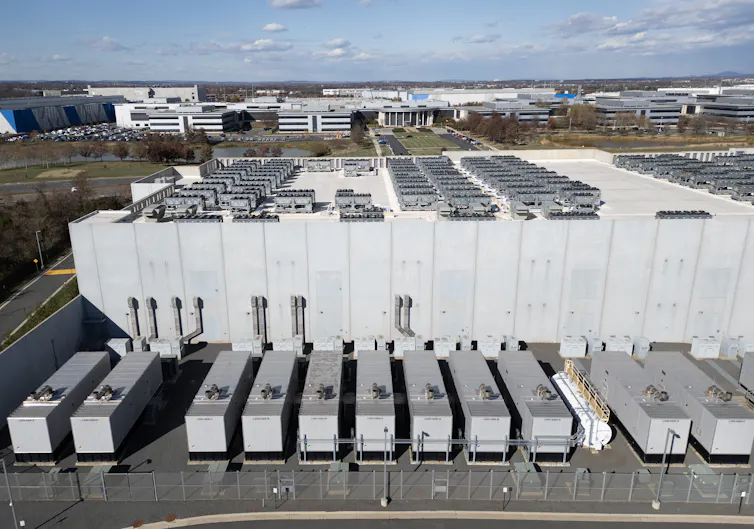
A row of generators sits alongside a data center building in northern Virginia. Andrew Caballero-Reynolds/AFP via Getty Images
Could data centers become part of Apopka's offset for property tax losses?
While no large-scale data center has been proposed in Apopka, the city's available land, expanding utility infrastructure, and location within one of Florida's fastest-growing metropolitan areas could make it a candidate for future data center development. Such facilities have become increasingly attractive to local governments because they can generate significant property value and tax revenue while placing relatively few demands on schools, parks, and other public services compared to residential development.
That economic equation could become even more important if Florida voters ultimately approve a constitutional amendment to reduce or eliminate property taxes. Cities like Apopka would likely face pressure to find alternative revenue sources to fund police, fire protection, road maintenance, and other core services. In that environment, commercial and industrial projects that generate substantial tax value could become a larger part of the conversation about the city's future growth strategy.
A data center would not be without tradeoffs. Researchers have raised concerns about their substantial electricity demands, water consumption, noise from cooling systems, and potential impacts on nearby neighborhoods. But if local governments find themselves searching for ways to replace declining property tax revenues, projects such as data centers, office parks, industrial facilities, and hotels may increasingly be viewed not simply as development opportunities, but as potential tools for closing future budget gaps while reducing dependence on residential growth.
Air pollution
Data centers generally operate 24/7 and consume enormous amounts of electricity, which must be generated somewhere – either near the data center or farther away.
When fossil fuels are burned to generate that power, they emit a wide range of air pollutants, including those linked to lung disease, cardiovascular disease, stroke and neurological conditions. They also emit heat-trapping pollution that causes global warming and climate change, which, in turn, worsens air pollution further.
Generating power for U.S. data centers in 2023 emitted the equivalent of 2.2% of the nation’s greenhouse gas emissions. Other air pollutants emitted from fossil-fuel combustion are associated with increased risk of ADHD and autism in children and risks of Parkinson’s and Alzheimer’s diseases in older adults.
Unless the energy powering data centers comes from clean energy sources, such as solar, wind or geothermal, generating that electricity also pollutes the air. People who live near fossil-fuel burning power plants, whether in communities that also host data centers or in distant states, are exposed to air pollution. And during electrical outages, on-site diesel generators kick in, releasing large amounts of air pollution that can harm data center employees and nearby residents alike.
Water consumption and pollution
Data centers require vast quantities of water to cool their servers. Globally, they are projected to consume between 4.2 billion and 6.6 billion cubic meters of water annually by 2027. In the United States, data centers already rank among the top 10 industrial water users.
In northern Virginia, data center water use has risen sharply. In Loudoun County alone, just northwest of D.C., potable water use by data centers more than doubled between 2019 and 2023, while facilities across northern Virginia consumed nearly 2 billion gallons of water in 2023.
This demand can strain local rivers, aquifers and municipal water systems, even in regions like the mid-Atlantic that are not usually prone to drought, but especially in regions like the U.S. Southwest that face persistent droughts.
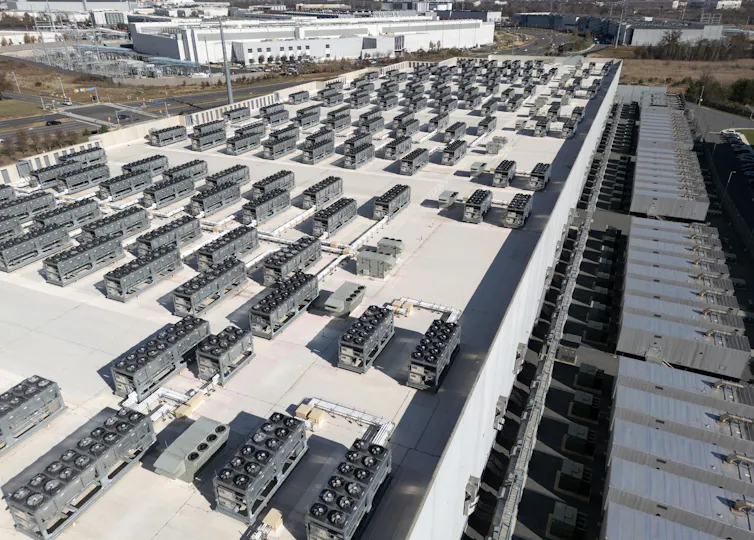 Cooling fans on data center roofs can spread noise and vibrations. Andrew Caballero-Reynolds/AFP via Getty Images
Noise pollution
Data centers’ continuous operation means that cooling systems, including air chillers and cooling fans, generate a persistent humming sound around the clock – as do any generators that are in use to provide power.
In northern Virginia, some residents have complained about an industrial-scale “drone” or “hum.” Measurements at the data centers that were the subject of complaints found noise levels were between 40 and 59 decibels on residential property.
Those noise levels are quieter than a conversation with someone 3 feet away and not loud enough to damage people’s hearing or violate local noise ordinances. But they are close to levels the EPA says reduce people’s ability to work, sleep and exercise. Some people have complained that data center noise has given them trouble sleeping and concentrating, and some have said they avoid using their homes’ outdoor spaces, where the noise is louder.
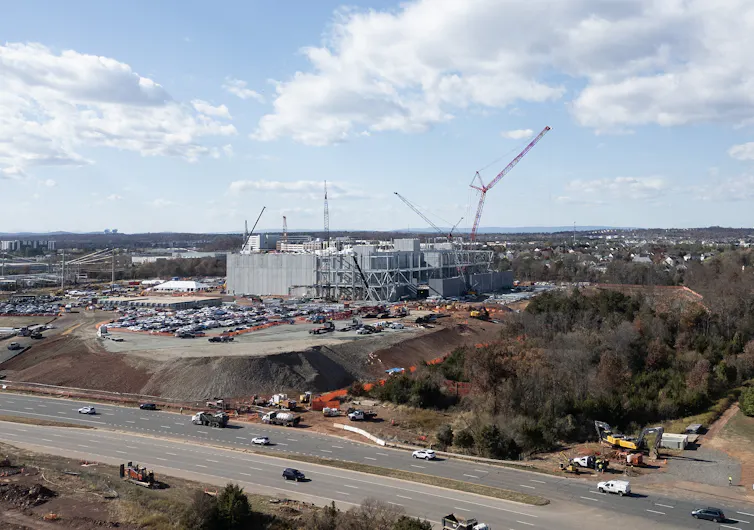 A data center under construction in Ashburn, Va., in November 2025. Andrew Caballero-Reynolds/AFP via Getty Images
Land use and community well-being
Data center expansion often targets land near green spaces, agricultural areas or rural communities where developers can secure affordable land with access to existing electricity supplies.
Converting green space into industrial facilities can diminish health benefits associated with being in and near natural environments, including opportunities for physical activity and improved mental well-being.
In Virginia, residents living near data center construction have reported increased exposure to truck traffic and diesel exhaust, which can contribute to respiratory and cardiovascular health risks, especially in children and older adults. While these effects are typical of large construction projects, they can be amplified when several data centers are clustered together.
In places like Prince William County, Virginia, developers have proposed data centers on roughly 2,400 acres of undeveloped land in the Rural Crescent, an area designated by the county’s planners to remain relatively undeveloped. Those data centers could transform open space and rural farmland into industrial zones, disrupting communities with long-standing ties to the land.
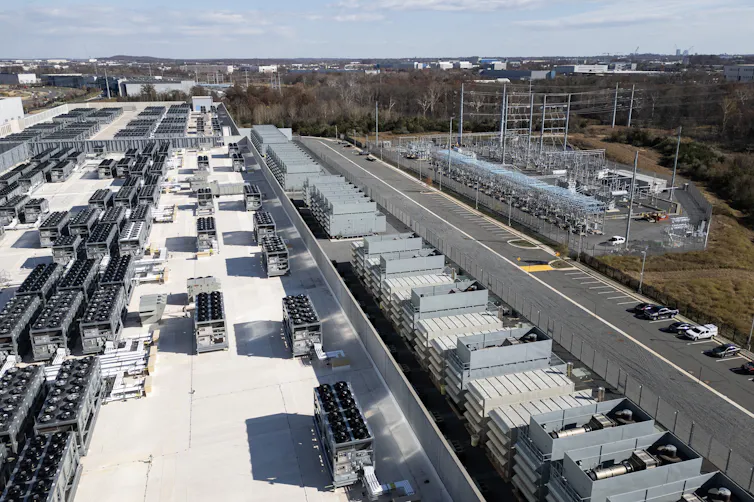 Data centers use large amounts of electricity. Andrew Caballero-Reynolds/AFP via Getty Images
Rising energy costs
As data centers increase electricity demand, they put upward pressure on energy prices across the grid. A 2024 Virginia legislative report found that the state’s typical residential electricity bill could rise by $14 to $37 per month by 2040 because of grid strain tied to data center growth – a 9% to 25% increase over current average bills, and a figure that does not factor in potential inflation.
These higher costs are paid by all consumers, but they place a greater burden on families that are most economically distressed, who also tend to have more health problems. Lower-income families spend a higher share of their budget on electricity, and when bills rise, the consequences can include reduced access to adequate heating and cooling, increased risks of heat-related illness and cold-related cardiovascular stress, as well as difficult choices between paying for energy and food or healthcare.
What can be done
Many of these health harms can be mitigated through better planning and design.
Increasing the share of renewable energy used to power data centers would help reduce air pollution and associated health harms.
Using recycled water in targeted systems that cool individual server rows or racks rather than whole buildings can significantly reduce cooling energy demand, with some studies estimating reductions of up to 29%.
On noise, a Leesburg, Virginia, data center reduced low-frequency tonal noise by reengineering its fan mounts.
And on energy costs, requiring large-scale data centers to cover more of the grid costs they create could help protect residential customers from higher electricity bills.
The world’s digital infrastructure runs through data centers, and that is not changing. We believe that expanding this infrastructure without protecting the health of surrounding communities is an unacceptable option.
Key Points:
• Data centers currently consume about 4.4% of all U.S. electricity, a figure expected to rise to as much as 12% by 2028 as demand for AI and cloud computing accelerates.
• Power generation for data centers contributes to air pollution and greenhouse gas emissions, while backup diesel generators can create additional health concerns during outages.
• Data centers require enormous amounts of water for cooling, with facilities in Northern Virginia alone using nearly 2 billion gallons of water in 2023.
• Residents living near data centers have reported concerns about constant low-frequency noise, construction impacts, increased truck traffic, and the loss of green space.
• Researchers warn that growing electricity demand from data centers could lead to higher utility bills for residential customers, particularly affecting lower-income households.
This article is republished from The Conversation under a Creative Commons license.